Roller Recovering
Home
Recover
recovering
Replacing Worn Coverings Without Replacing the Roller
Recovering replaces worn or damaged roller coverings while preserving the underlying core. This service is ideal when the roller body remains structurally sound, but surface performance has declined due to wear, chemical exposure, or thermal stress.
Recovering also provides an opportunity to upgrade materials or surface characteristics to improve performance.
Covering and Coating Materials
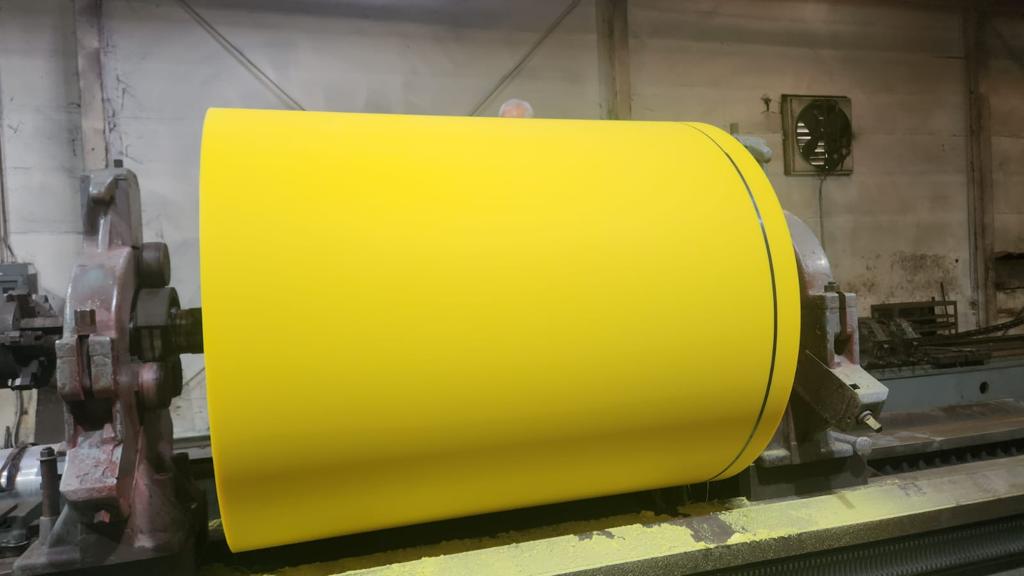
Polyurethane
Polyurethane covers provide excellent wear resistance, load capacity, and traction. They are commonly used where durability, consistent grip, and long service life matter.
For a paper mill’s wet end, Thistle makes XUC-750D Composithane, a hydrophobic polyurethane cover for rolls that run under continuous moisture. The XUC-750D product sheet (PDF) identifies breast, wire, felt, and guide rolls as applications.
For rolls exposed to abrasive material or sharp edges, see the ThistleFusion XtremeGlass product sheet (PDF). It describes Thistle’s hybrid polyurethane covering and its applications in steel, paper, and packaging.
Chrome
Chrome coatings create a hard, smooth surface with strong corrosion resistance. They are often used where abrasion resistance and precise surface finish are required.
Ceramic
Ceramic coatings offer extreme hardness, heat resistance, and chemical stability. They are well suited for high-temperature or highly abrasive environments.
Silicone
Silicone covers resist high temperatures and release easily from sticky materials. They are typically used in applications where heat tolerance and non-stick performance are critical.
Tungsten Carbide
Tungsten carbide coatings deliver exceptional wear resistance and surface hardness. They perform well in aggressive, high-wear applications where long coating life is required.
Teflon / Teflon Sleeves
Teflon provides a low-friction, non-stick surface that resists buildup and material adhesion. Sleeves are often used when easy replacement or quick changeovers are needed.
HVOF Carbide Coatings
HVOF-applied carbide coatings create dense, tightly bonded surfaces with high wear resistance. This process is used when coating integrity and long-term performance are priorities.
Felt / Textile Wrap
Felt and textile wraps provide cushioning, absorption, or gentle material handling. They are commonly used in conveying, finishing, or delicate surface contact applications.
Recovering Process
Evaluation, Application, and Verification
Existing coverings are removed and the core is inspected for integrity. New coverings are applied, cured, and finished to specification, followed by final grinding, balancing, and inspection prior to return to service.
Ready to Recover a Roller?
If surface wear is affecting performance but the core remains sound, recovering may be the most efficient solution.
Services
Menu
Have Questions? Give us a call!
- (562) 948-3705